


Artificial intelligence explained simply: at first, that sounds like a contradiction. After all, many people still regard AI as a complex technology of the future. In reality, however, we have long been encountering artificial intelligence in everyday life. From a simple recipe query to a complex coding task – it writes texts, recognises images, analyses data and helps companies to make decisions faster and on a sounder basis.
Nevertheless, one central question remains open for many people: what is really behind it? Because explaining artificial intelligence simply means more than just understanding a few technical terms.
That is why, in this article, we explain artificial intelligence as simply as possible. Understandable, practical and with a look at what this technology can already do today and where the development is heading.
Key facts at a glance
- Artificial intelligence explained simply: AI refers to systems that learn from data and can make decisions or predictions independently.
- AI is based on algorithms, large volumes of data and learning models.
- Typical applications are voice assistants, image recognition, automated analyses or intelligent software solutions.
- For companies, AI opens up enormous opportunities for increasing efficiency, automating processes and improving data analysis.
Artificial intelligence explained simply – when machines learn
The term seems complicated at first, but at its core artificial intelligence can be explained simply by reducing it to one basic idea: computers are programmed so that they can learn from data and recognise patterns on their own.
While conventional software works strictly according to fixed rules, AI can improve its results with growing experience. The more data a system processes, the more precise its forecasts or decisions become.
A simple example: an AI system is supposed to recognise cats in pictures. To do this, it is trained with thousands of photos: some show cats, others do not. Little by little, the system recognises typical features such as ear shape, fur texture or eyes.
With enough training data, the software can later decide on its own whether a cat can be seen in a new picture. So if you are wondering what AI is, remember this: AI is software that not only executes commands, but learns from experience.
How does AI work in everyday life?
To really understand how AI works, it is worth taking a brief look at the most important building blocks. Behind every AI application there is essentially an interplay of data, mathematical models and continuous learning.
Data
AI needs large volumes of data in order to recognise patterns. The more examples a system uses as a basis, the better it becomes at understanding relationships. In practice, these can be images, texts, measurements or usage data.
A voice assistant, for example, learns from millions of voice recordings how people speak and which words belong together.
Algorithms
Algorithms are the mathematical models with which AI systems analyse data. They recognise recurring structures and develop decision rules from them. Modern AI frequently uses so-called neural networks for this – models that are loosely reminiscent of the structure of the human brain.
Training
During training, the system is fed with examples. In the process, the AI receives feedback on whether its assessment was right or wrong. Step by step, the model adjusts its calculations and thereby becomes ever more accurate.
Application
After training, the AI can apply what it has learned in real applications. For example, it recognises objects in images, analyses large volumes of data or supports forecasting. Many systems even continue to learn as new data is added.
AI has many faces – key types at a glance
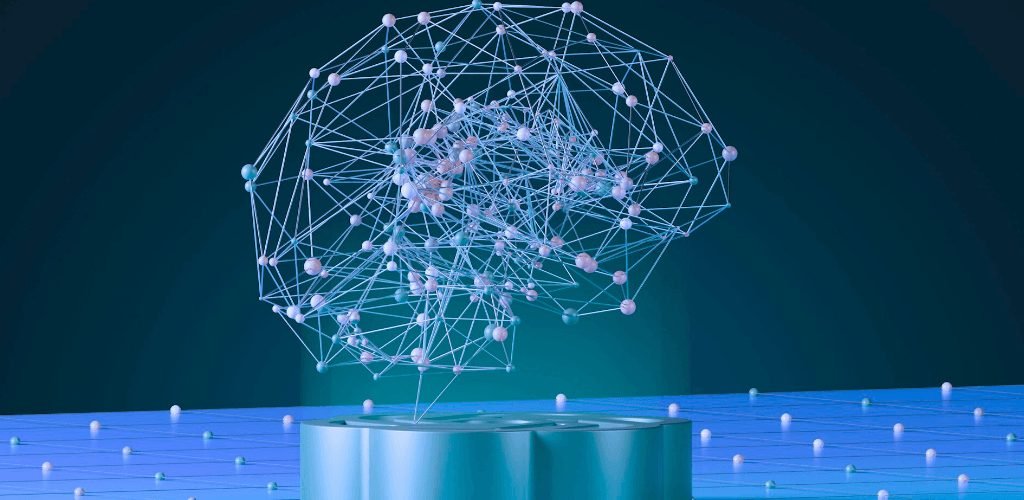
If artificial intelligence is to be explained simply, it is helpful to understand that there is not just one single kind of AI. In fact, experts distinguish several categories.
Weak AI (narrow AI)
Most of the systems we use today belong to so-called weak AI. These systems are specialised in one specific task, for example:
- voice assistants
- recommendation systems in online shops
- automatic translations
- image recognition or facial recognition
Such systems can perform their specific task very well – but nothing beyond that.
Strong AI (artificial general intelligence)
Strong AI is more of a concept for the future. It refers to systems that could fully replicate human intelligence, i.e. learn flexibly, solve complex problems and handle several tasks at the same time. However, such systems do not yet exist.
Generative AI
A particularly dynamic development of recent years is generative AI. These systems can create new content, for example:
- texts
- images
- music
- program code
In contrast to conventional AI systems, which primarily analyse or sort, generative AI independently creates new content on the basis of learned patterns.
Well-known examples are large language models such as GPT models, which can formulate texts, answer questions or summarise content. Image generators such as DALL·E or Midjourney, which create realistic or creative images from simple text descriptions, also belong to this category.
Such models impressively demonstrate how quickly AI is developing. That is exactly why simply explained artificial intelligence is increasingly being discussed today in the context of creative applications – from marketing and design to software development and knowledge work.
What AI really changes in practice
The more companies engage with the topic, the clearer it becomes: explaining artificial intelligence simply also means understanding its effects. Because AI does not just change individual processes – it changes entire ways of working.
Efficiency through automation
AI can take over recurring tasks, such as:
- data analysis
- quality checks
- customer enquiries
- forecasts in planning
More precise decisions through data analysis
Another advantage lies in the analysis of enormously large volumes of data. AI recognises patterns that are barely visible to humans. This allows companies to identify trends earlier, assess risks better and make better-founded decisions.
New opportunities for innovation
Many new digital products are based directly on AI technologies. From personalised services to intelligent assistance systems, entirely new business models are emerging.
Challenges in the use of AI
Alongside all the possibilities, AI naturally also brings a few stumbling blocks with it. Topics such as data protection, the traceability of decisions, clean integration into existing processes or the quality of the training data play a central role here.
This is precisely why it is worth explaining artificial intelligence simply. Because only when everyone in the company understands how AI works and where its limits lie does a healthy sense of opportunities, risks and the sensible use of this technology emerge.
AI is a powerful tool – with the right strategy
When artificial intelligence is explained simply, it quickly becomes clear: AI is not a magical, mysterious technology, but a powerful tool. Used correctly, AI can help companies to design processes more efficiently, make better use of data and develop new innovations.
At the same time, clear strategies, experience and sensible integration into existing structures are needed to unfold its full effect.
This is exactly where BE BRAVE provides support: with well-founded consulting, strategic AI integration and tailored solutions, the company helps organisations not only to understand artificial intelligence, but to use it productively. In this way, a complex technology topic becomes a concrete competitive advantage.
FAQ
How do you explain artificial intelligence simply?
AI describes computer programs that learn from data and can recognise patterns on their own. This enables them to take over tasks that previously required human decisions.
Where is AI used today?
AI is used in many areas today, for example in medicine, industry, logistics, financial analysis or customer service. Voice assistants and automatic translations are also based on AI technologies.
How does AI work in principle?
If you want to understand how AI works, remember three central steps: collecting data, training models and recognising patterns. Through this learning process, the AI improves continuously.
Can AI replace human intelligence?
Current systems are so-called weak AI. They are specialised in clearly defined applications, but cannot think or learn flexibly like humans. A true general AI does not yet exist.


